Training
Every set logged. Every variable controlled.
Built by a lifter who wanted to know whether a PR was real progress or just a different seat height. Log sets, reps and RIR in seconds, and Corpus remembers everything else that could skew the comparison.
Get early access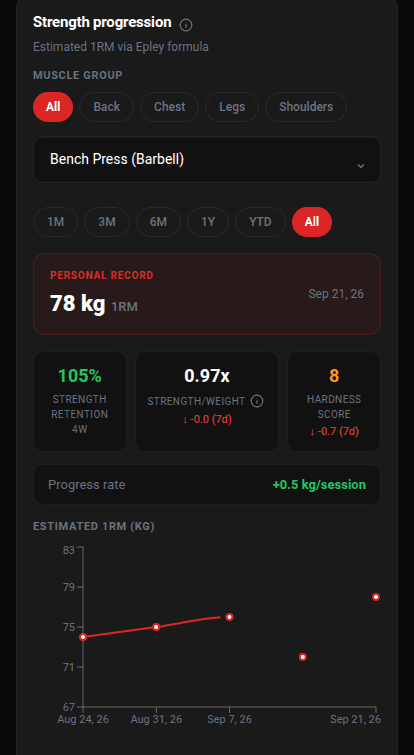
Standardised down to the seat height.
Effort on every set, not just weight and reps.
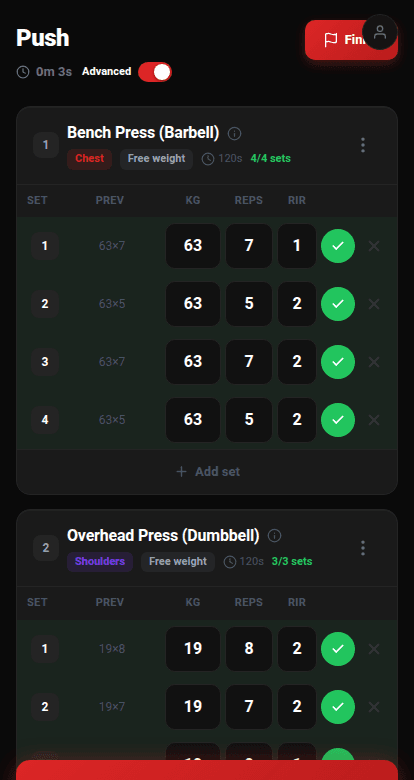
Switch on Advanced mode and every set gets a RIR field: how many reps you had left in the tank. Two sets of 8 at the same weight aren't the same set if one was at RIR 3 and the other at RIR 0.
Go deeperShow less
Warm-ups, working sets and dropsets each get their own marker, and dropsets skip the rest timer automatically. Your previous session sits next to every set, so you always know what to beat.
Every machine setting, remembered.
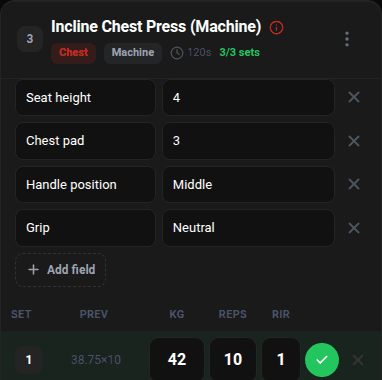
Seat height, chest pad, backrest, handle position, grip: add your own fields per exercise and they're there next session, ready before your first set.
Go deeperShow less
Settings are stored per gym, because seat 4 on one leg press isn't seat 4 on another. Machine and cable exercises also compare only against sessions at the same gym; free weights compare everywhere.
Multi-pin machines, pin by pin.
Plate-loaded and multi-stack machines like Prime have more than one resistance path. Corpus logs each pin's load separately, so a change in one path doesn't hide inside a single total.
Go deeperShow less
Brand and machine type are saved with the exercise, so a selectorized stack with one dial and a Prime machine with several pins are never treated as the same thing.
Coming soon: straps, wraps and belts.
Log lifting straps, wrist wraps and a belt per set, so a heavier row with straps doesn't get compared to one without. The same idea as the machine settings: compare like with like.
One number for how hard it really was.
Session load is your perceived effort (1–10) times the minutes you trained: the Foster method, a published sports-science formula for training stress. Estimated 1RM, volume and strength trends follow automatically.
Ranked the way real meets are.
The opt-in leaderboard uses Wilks 2020, a published strength-normalisation formula, so lifters of different bodyweights compare fairly. Next to it: growth, volume, body composition, and one pillar that's just for fun.