Insights
Your body, your own experiment.
Every body reacts differently. Corpus turns your own logs into small studies, so you see how YOU respond to late caffeine, a heavy leg day, an eye mask or an extra hour of sleep.
Get early access
Research, but about you.
Replicate real studies on yourself.
Dozens of questions come straight from published research: does late caffeine cut your sleep, does a hard training week lower your HRV, does tryptophan in the evening help you sleep? Corpus checks whether the effect shows up in your data.
Go deeperShow less
Where a test comes from a study, Corpus links to it, so you can see what the research found in a group of people and compare it with what your own data says.
Try something, see what changes.
Mouth tape, a nasal strip, an eye mask, dinner an hour earlier: tag it and keep logging. Night by night you see whether it makes a difference for you, or whether it's just a trend on social media.
Go deeperShow less
Tagging takes one tap in your evening or morning check-in. Corpus then compares the nights with and without, using your own sleep score, sleep stages and resting heart rate.
A result only appears once there's enough data on both sides. Until then the card simply shows how many more nights it needs, so you never read too much into three good nights.
Discover what moves together.
Steps and sleep, training volume and HRV, bedtime and sleep quality. Corpus shows which of your habits go together with your results, and how strong the link is.
Go deeperShow less
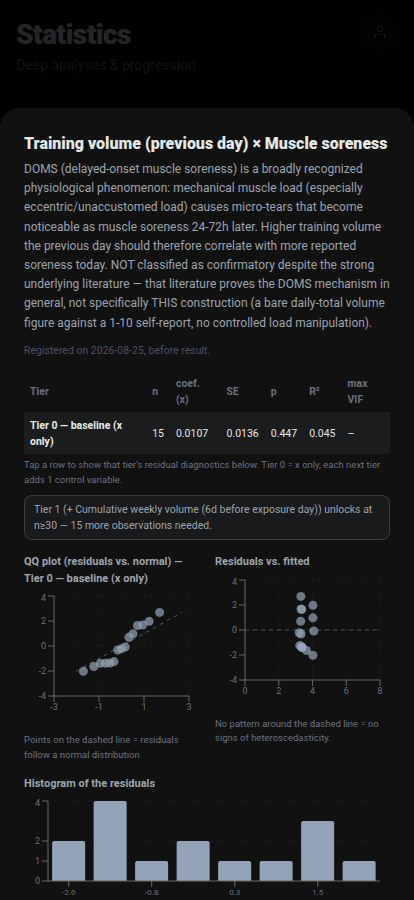
A link isn't automatically cause and effect. Where it matters, Corpus corrects for other factors, like training load or sleep duration, and tells you how sure the result is.
Only real patterns make the cut.
It's easy to find a pattern in anything if you look long enough. Corpus uses the same safeguards researchers use, so a lucky coincidence isn't presented as a discovery.
Go deeperShow less
11 core tests with strong backing in the research are fixed in advance and corrected together (Bonferroni). Without that, running 11 tests gives a 43% chance that one looks significant by luck alone.
68 exploratory tests in four families (sleep, nutrition timing, recovery, strength) use a false-discovery-rate correction.
Deeper regression runs in a separate Python service (numpy, SciPy, statsmodels) that has no database access and only receives anonymous number arrays.
And some just out of curiosity.
Not every question needs a study behind it. Does the full moon change your sleep? Does a sunny day lift your energy? Curiosity experiments are clearly labelled as exploratory or speculative, so a fun hunch never gets mixed up with established science.