Nutrition
Know what's in your food, not just the calories.
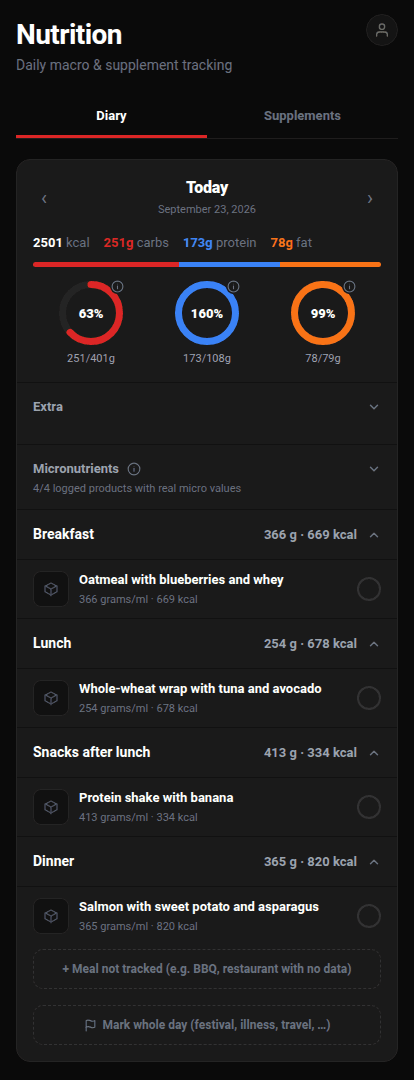
Scan a barcode or search thousands of foods. Corpus goes further than macros: fatty acids down to EPA and DHA, every essential amino acid, and 49 nutrients in total, each one labelled measured or estimated.
Get early access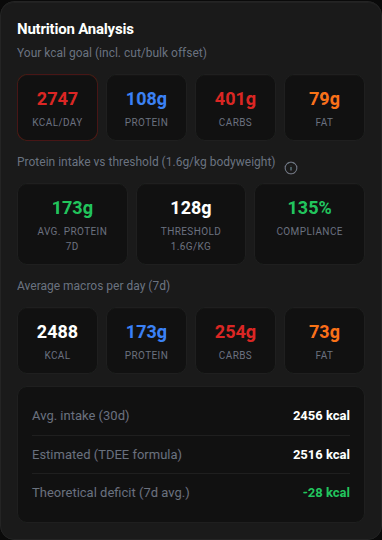
Protein, 7-day average
176 g 138% of target
As deep as you want to go.
Logged once, never rewritten.
Scan a barcode and the macros land instantly. Protein, carbs, fat and calories are locked the moment you log, so correcting a product later never changes what you saw that day.
Go deeperShow less
Products come from barcode databases first. When a label is incomplete, Corpus matches the food to the Dutch national food composition table (RIVM NEVO) to fill the gaps.
Eating something you can't log, like a barbecue or a restaurant meal? Mark it as untracked, so the day is flagged as incomplete instead of looking like you undereat.
Fat, split the way it matters.
Not just total fat: saturated, mono- and polyunsaturated, and within those the omega-3s (EPA, DHA, ALA) and omega-6 (linoleic acid).
Go deeperShow less
EPA and DHA are the long-chain omega-3s found in fatty fish and fish oil. ALA is the plant-based omega-3, and your body converts only a small part of it into EPA and DHA, so Corpus tracks them separately.
The omega-3 to omega-6 card compares absolute intake of both, not just the ratio, because a “good” ratio can still hide an intake that's too low on both sides.
Every essential amino acid.
Protein quality, not just grams: leucine per meal, the other essential amino acids against a reference pattern, and tryptophan tracked for sleep.
Go deeperShow less
Leucine is the amino acid that switches on muscle protein synthesis. Research points to roughly 2.5 g per meal as the threshold (Witard 2014), so Corpus shows it per meal, not only per day.
Histidine, isoleucine, lysine, methionine and cysteine, phenylalanine and tyrosine, threonine, tryptophan and valine are compared against the FAO reference pattern, the same basis as the DIAAS protein-quality score.
Tryptophan is a building block of serotonin and melatonin. Corpus tests whether your evening intake shows up in your own sleep, based on Sutanto 2022.
Minerals and vitamins, measured or estimated.
Nineteen minerals and vitamins, each with a badge that tells you whether the number comes from the product label or was estimated from a matched reference food.
Go deeperShow less
Some nutrients are often missing from branded labels. Potassium is a common example. Instead of silently showing zero, Corpus estimates it from the matched reference food and labels it as estimated.
The sodium to potassium balance gets its own daily view, because processed food tends to be high in one and low in the other.
Fuel matched to your training.
Protein against a threshold scaled to your bodyweight, and energy availability: what's left for your body after training.
Go deeperShow less
Protein threshold: 1.6 g per kg of bodyweight per day, the level above which extra protein adds little muscle for most lifters (Morton 2018).
Energy availability is your intake minus exercise energy, per kg of fat-free mass. Consistently low energy availability hurts recovery and performance, so Corpus tracks the 7-day trend instead of single days.
Supplements, caffeine and water, in the same place.
Log your whole supplement stack in one tap across nine categories, and supplements count towards your daily nutrient totals.
Go deeperShow less
Caffeine is logged even when it's zero, so caffeine-free days count as real data points in your sleep analyses instead of disappearing as missing.
Water intake has its own quick log, and reminders can nudge you in the evening if something wasn't logged yet.